
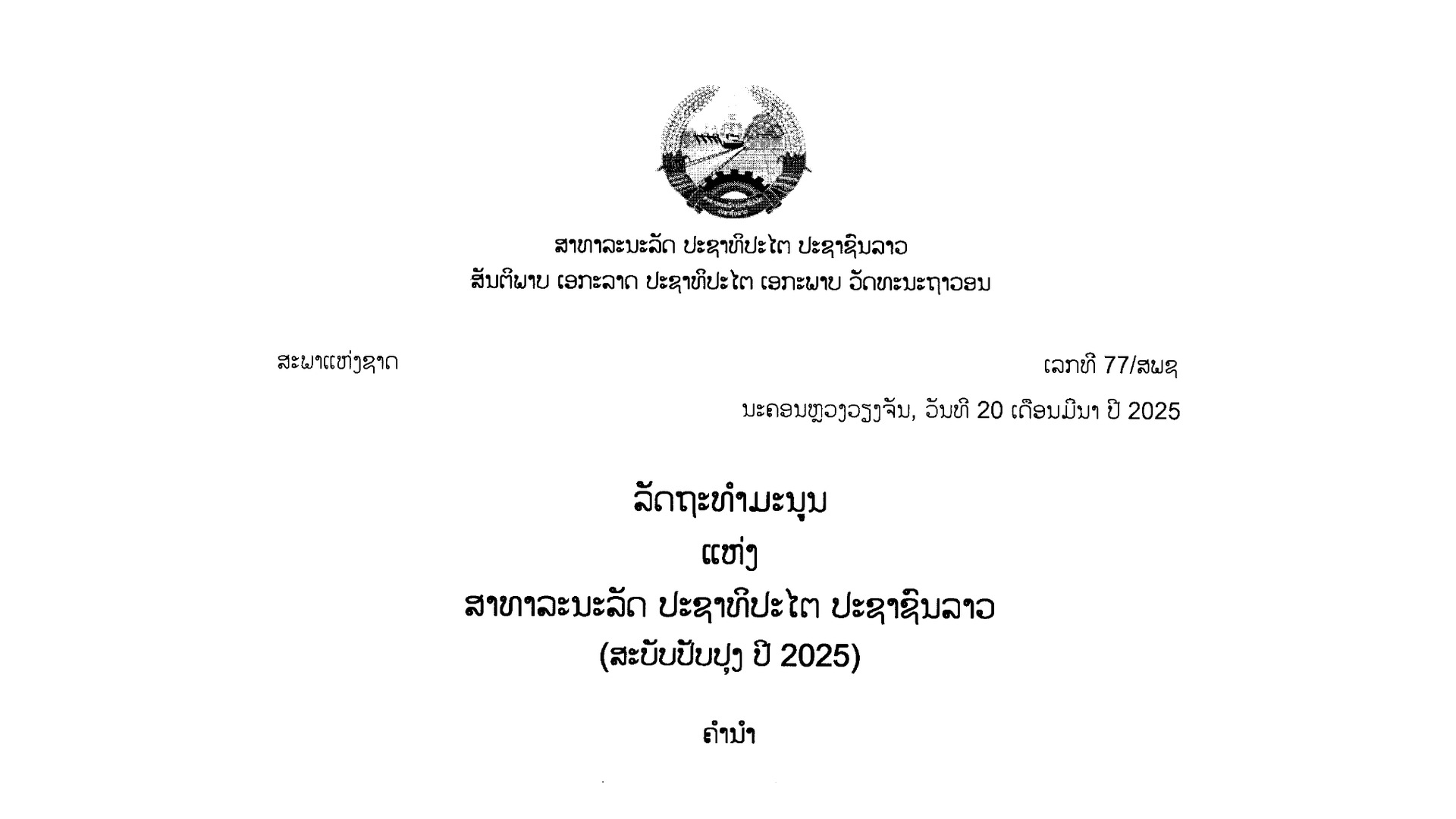
The Lao constitution has one line that is warm to read: "All powers belong to the people, by the people and for the interests of the people." Every 15 August we mark Constitution Day, remembering the day the first constitution was promulgated in 1991.
But ask yourself this: if something truly belongs to us, we should have had a hand in making it, we should know it, and we should be able to use it to protect ourselves. Is the Lao constitution like that?
This essay doesn't set out to say who is right or wrong. It only wants to look at the gap between the idea that the constitution belongs to the people and the way it has actually been written and used. Then you can judge for yourself.
First, we need to be clear about what a constitution is for.
A contract between state and people
Think about renting a house. Before you move in, you and the owner agree on terms and write them down: how much the rent is, when the owner may come in, how problems get solved. That contract isn't decoration. It exists so the weaker side has something to stand on when the stronger side goes too far.
A constitution is similar, only much bigger. In general political thinking, it is a contract between the state and the people. It says what the state may do and where its power stops. It says which rights people have that no one may touch. The idea of a "state governed by law" grows from this: rulers, too, live under the law like everyone else. The Lao constitution itself says it is "the fundamental law of the nation" and that all laws must conform to it.
Seen this way, the key question isn't just "is there a constitution?" It is: who wrote the contract? And whose power does it limit?
Without a contract
The Lao PDR was founded in December 1975. The royal-era constitution was abolished that same month. But no new one took its place. For 16 years the country had no constitution at all. The Supreme People's Assembly was given the drafting job from the start, but historian Martin Stuart-Fox notes that after the committee was set up, "nothing was heard" for years.
What do 16 years mean for an ordinary person? Back to the rented house: it's like living there with no contract. On days the owner is kind, fine. But when trouble comes, you have no piece of paper to hold up. Amnesty International wrote in 1985 that without a constitution or a published penal code, citizens were "effectively denied proper legal guarantees" of their human rights. And, interestingly, the Party's own newspaper admitted in 1990 that having no laws was "a source of injustice and violation".
So the need for a contract wasn't something outsiders made up. The state saw the problem too. The next question, then: once it was written, how was it written?
Written for us to read, or written with us?
As drafting sped up in the late 1980s, National Radio of Laos reported that the committee worked "under the close supervision of the Political Bureau and the Secretariat of the Party Central Committee". The draft went to the Politburo first, and only then out for comment. A Party directive set the order of discussion: "first among party and government officials and then among the public".
Asking for comment is a good thing. But "asking for comment" and "writing together" are not the same. It's like an owner who finishes the contract and then holds it out: "Any comments?" And sometimes the asking wasn't real. A Party directive of June 1990 itself noted that in many places, when people were called to meetings, they were "simply given question and answer sheets to study".
Some people did take the consultation seriously. About 40 officials and intellectuals called for a multiparty system and criticised the article on the Party's leading role. In October 1990, three of their leaders were arrested and held without trial. The final text was adopted unanimously in August 1991.
The lesson: writing a constitution isn't just choosing words. It shows who has a voice, and which voices get heard.
Two sentences that say more than the page
Since 1991 the constitution has been amended three times. But two sentences have never changed in meaning.
The first is Article 3: the people's right to be masters of the country is exercised "through the functioning of the political system with the Lao People's Revolutionary Party as its leading core". Put simply: the people own the car, but who holds the wheel is already written into the contract.

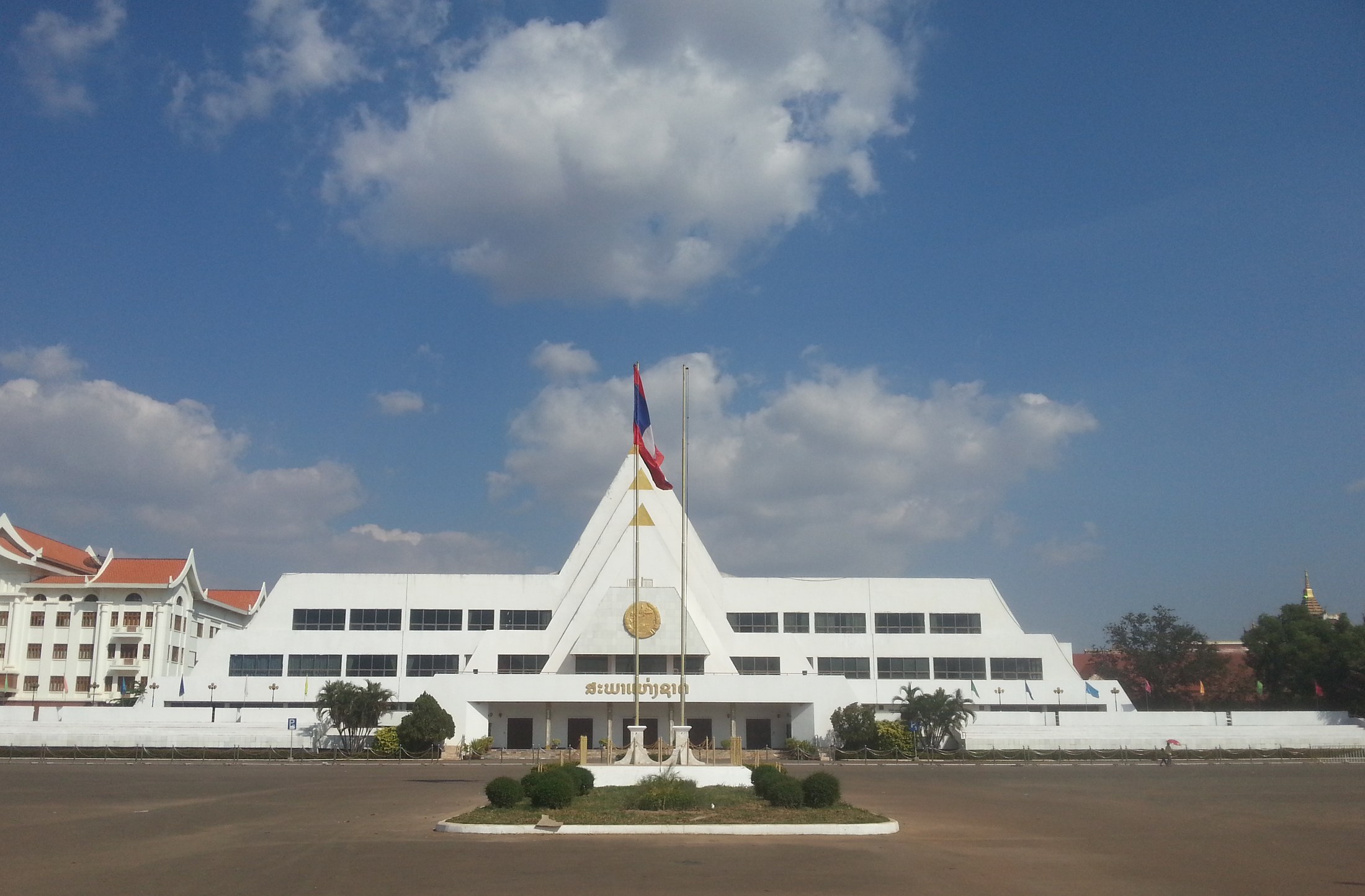
The second is the rights clause: Lao citizens have freedom of speech, writing, assembly, association and demonstration "provided these do not violate the law". That last phrase is short but heavy. In principle a constitution sits above ordinary laws. But when a right comes with the condition "not contrary to the law", its limits get drawn by lower laws written later. It's like a sign saying "Speak freely, if the rules allow", where someone else writes the rules. In 1990 Amnesty proposed that restrictions be only those "necessary in a democratic society"; the recommendation was "ignored".
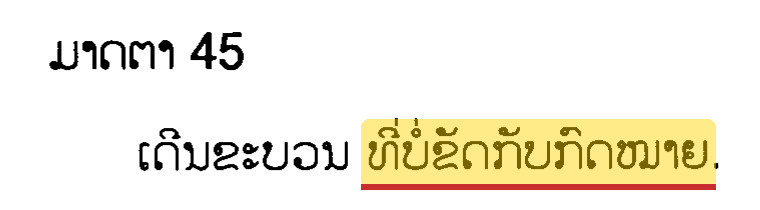
What does this look like in real life? Picture a young person making a satirical video about potholed roads back home. Amnesty reports that in 2024 two graphic artists in Bokeo were detained over exactly that kind of video. One had to attend "re-education" and publicly apologise before going home. The UN Human Rights Committee has also voiced concern about broadly worded penal code articles and a decree that criminalises online criticism of the government and the Party. The right is really on paper. But its limits are set somewhere else.

A door opening wider
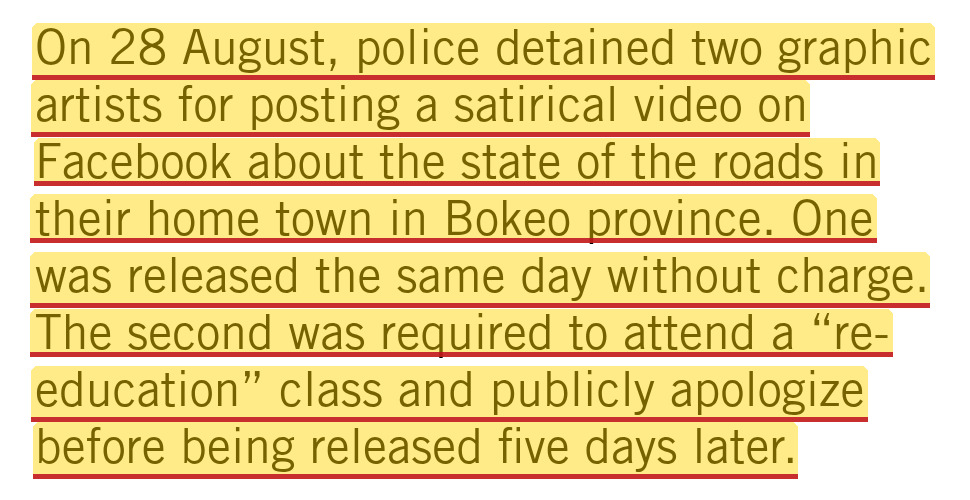
To be fair, each amendment opened the door to comment a bit wider. In 2015 there were several rounds of consultation, though participants were mainly provincial officials, experts, academics and retired officials. In 2025 the draft was published in the Official Gazette for comment, and the government set up an email address plus the National Assembly website for public input. That's a step worth mentioning.
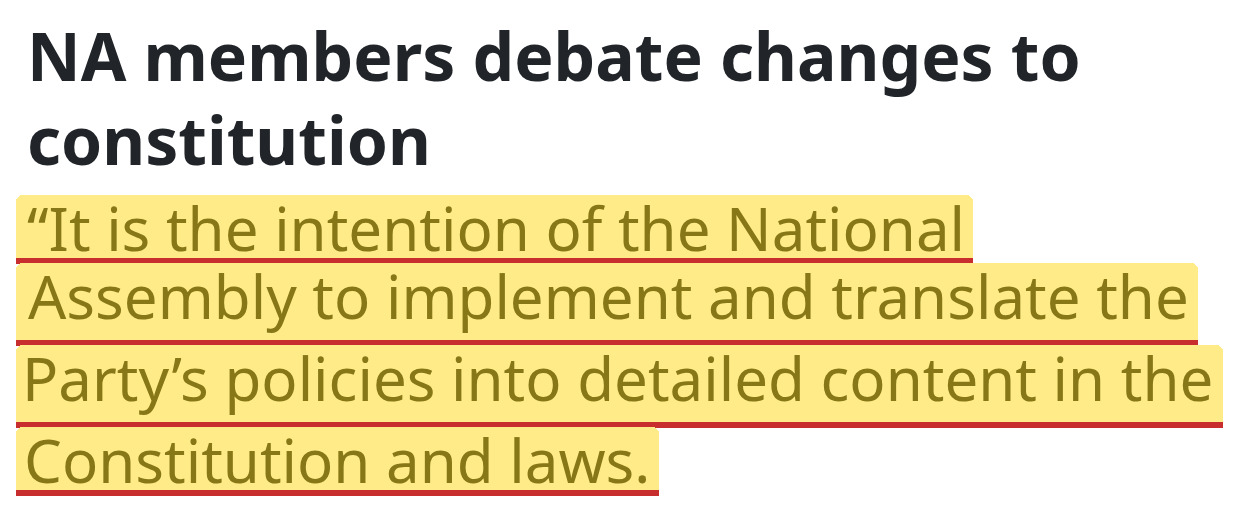
But an open door and people walking through it are two different things. Radio Free Asia reported that most people weren't interested, seeing it as "far from their lives", and we found no official figure for how many people sent comments. And what was on the table already had a clear direction: opening the 2025 session, the National Assembly President said the aim was "to implement and translate the Party's policies into detailed content in the Constitution and laws". Comment was open on the how; the direction was set beforehand.
The other side of the story
The Lao government sees this differently. In its 2025 report to the UN, it states that citizens "enjoy the right to freedoms of opinion, speech, expression, and media in line with the Constitution", with any limits "strictly in line with the International Human Rights Law". It also points to several hundred registered civil society organisations. Before the UN committee, the government argued that the cases raised "do not concern freedom of expression".
From this angle, a Party as leading core and laws that draw the boundaries are ways to keep stability and unity, not to take rights away from people. Outside observers such as Freedom House give Laos very low scores on free media and assembly. These two views are far apart. And that gap is exactly what this essay wants you to look at.
Back to the contract
Go back to the rental contract once more. A good contract isn't one that's nicely written. It's one both sides helped write, both sides can read, and the weaker side can really rely on when trouble comes.
The Lao constitution says all power belongs to the people. Its 34-year history shows both efforts to open the door and limits that have never moved.
So the question comes back to you: if the constitution is a contract, did you ever sign it? Has anyone ever really asked you? And if one day you need it, will it stand on your side?
Tell us below.
