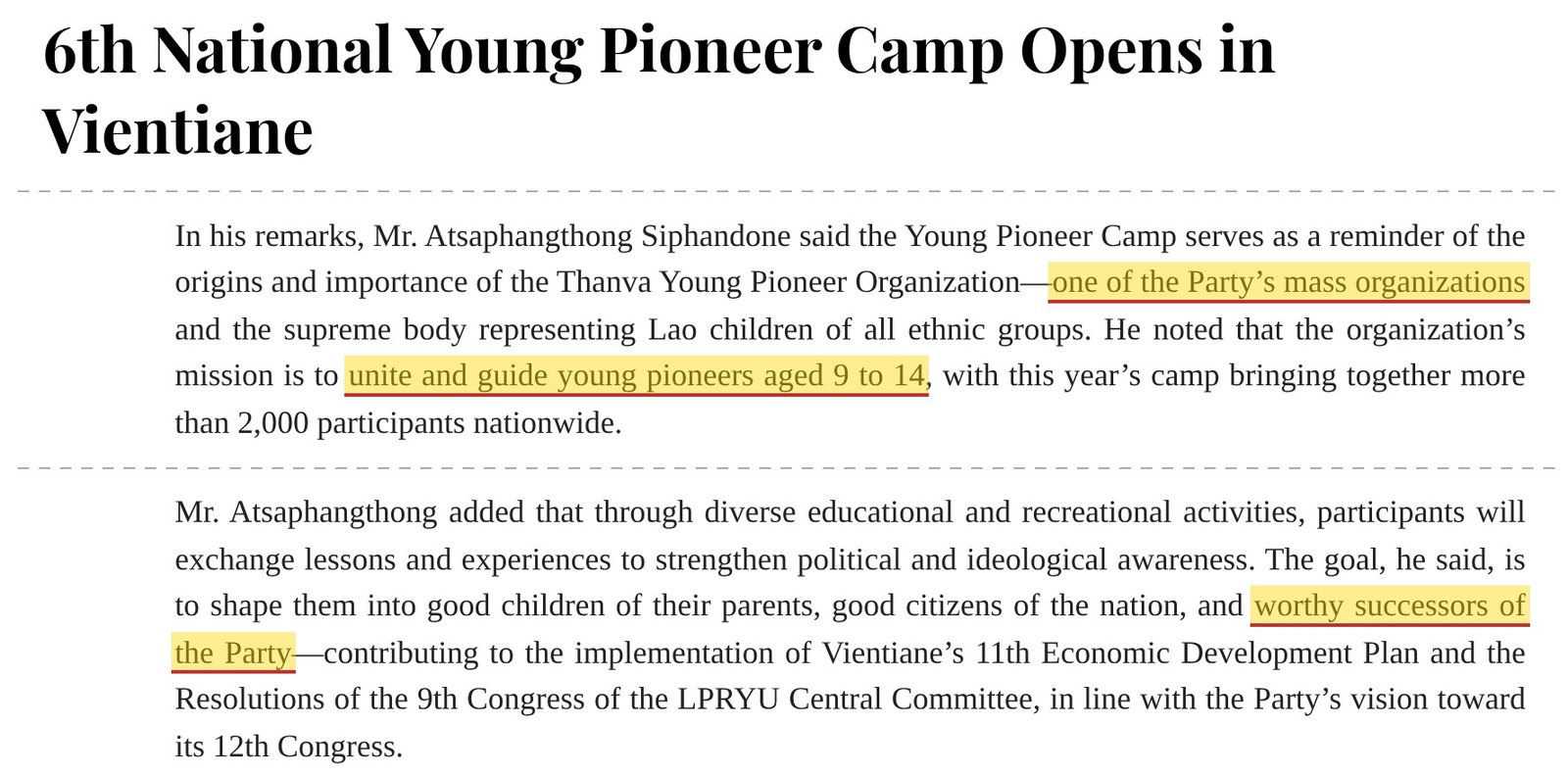
In November 2025, more than 2,000 children aged 9 to 14 from across the country gathered in Vientiane for the 6th National Young Pioneer Camp. The speaker who opened it said that the aim of the camp was to strengthen political and ideological awareness so that these children would become good sons and daughters to their parents, good citizens of the nation and "worthy successors of the Party".
Join up small points like this one, from textbooks, the Youth Union, the newspapers and the statues to the army, and you can see a long path that the Lao People's Revolutionary Party has laid down to cultivate loyalty to the Party in each generation of Lao people, most of it written openly in official documents.
Roots: the Party behind the Front
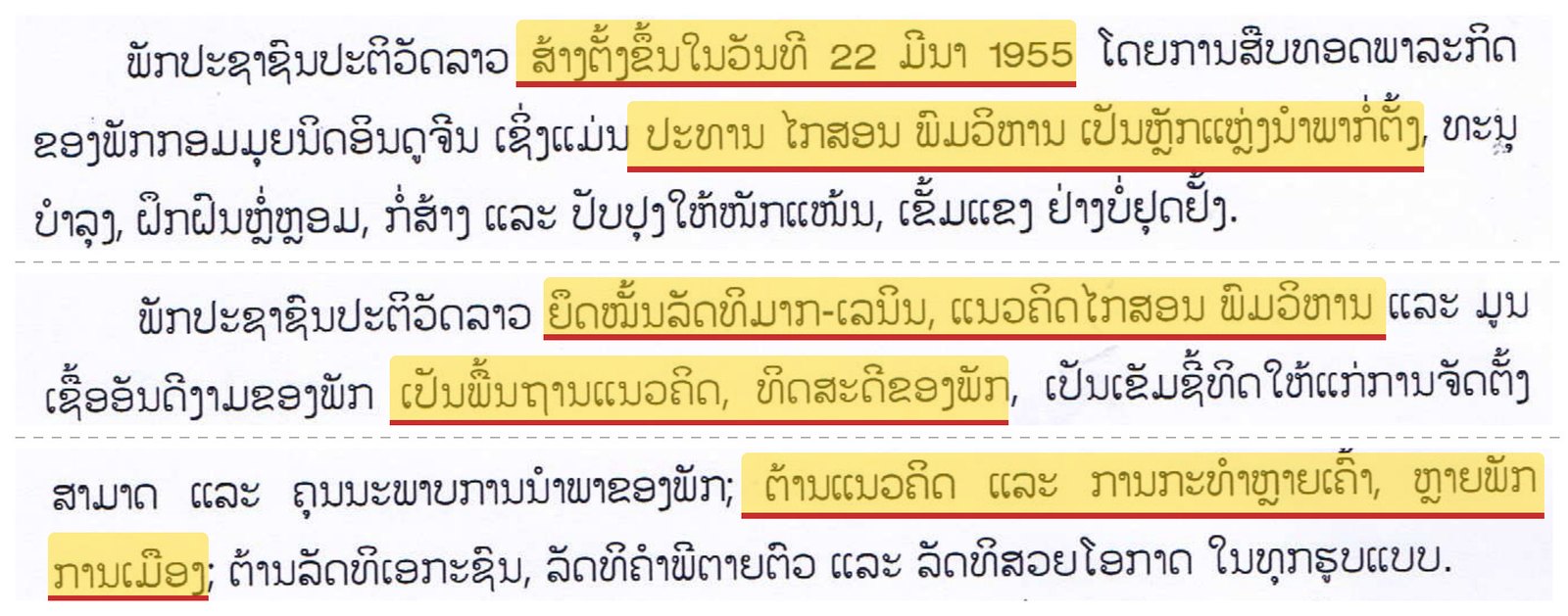
The 2025 amended Constitution begins by recounting that from 1930 the Lao people fought under the leadership of the Indochinese Communist Party founded by Ho Chi Minh, and later of the Lao People's Revolutionary Party. The Library of Congress country study of 1994 adds that the Lao People's Party was officially proclaimed at its 1st Congress on 22 March 1955 and took the name Lao People's Revolutionary Party at its 2nd Congress in 1972.
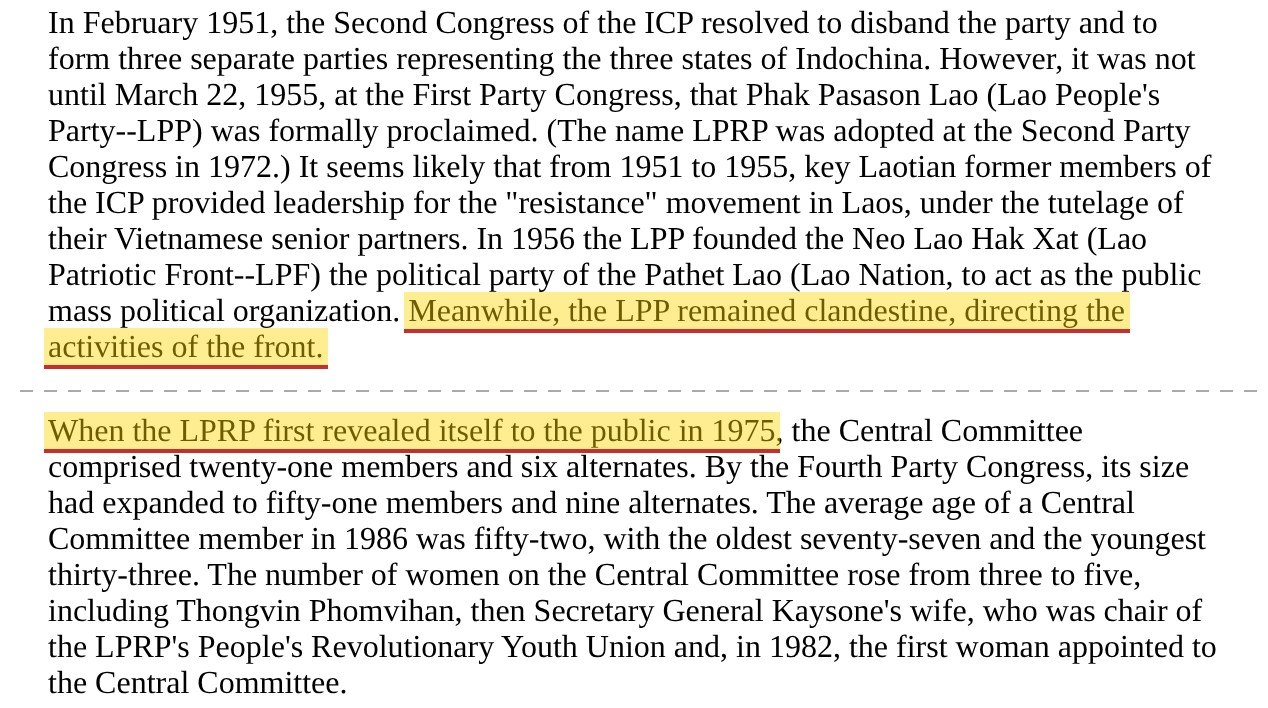
What is notable is that for the first 20 years the Party did not appear under its own name. The same source writes that in 1956 the Party set up the Lao Patriotic Front as a political organization of the masses operating in the open, while the Party itself stayed underground and directed the Front's work from behind. Only in 1975 did the Party announce itself to the public, so many Lao people during the war knew the revolutionary movement through the names of the Front and the Lao army rather than the name of the Party.
Today the 2021 Party Statute states in its preamble that the Party was "founded on 22 March 1955" with Chairman Kaysone Phomvihane as "the main founding leader", and it makes Marxism-Leninism and Kaysone Phomvihane Thought the ideological and theoretical foundation of the Party and requires opposition to "ideas and actions of multiple centres and multiple political parties". Article 4 further requires every Party member to "eagerly study" that theory and those ideas.
Seminars after 1975
After the Lao People's Democratic Republic was proclaimed on 2 December 1975, the Library of Congress study records that cadres were assigned to propagate the new order and that seminars were held to give political education to every category of people.
For officials and soldiers of the old regime, the seminars turned out to be much longer than many expected. A 1980 Amnesty International report records that civil servants from several ministries were sent to seminars from mid-1975 and that some "had volunteered to attend the seminar, thinking it would last only a short time". There is no official figure for the number of people held, only estimates by outside observers, which vary from 10,000 to 40,000, with the higher figure including ordinary criminals, while former Prime Minister Prince Souvanna Phouma stated in March 1979 that about 10,000 to 15,000 former civil servants and army officers had been held since 1975.
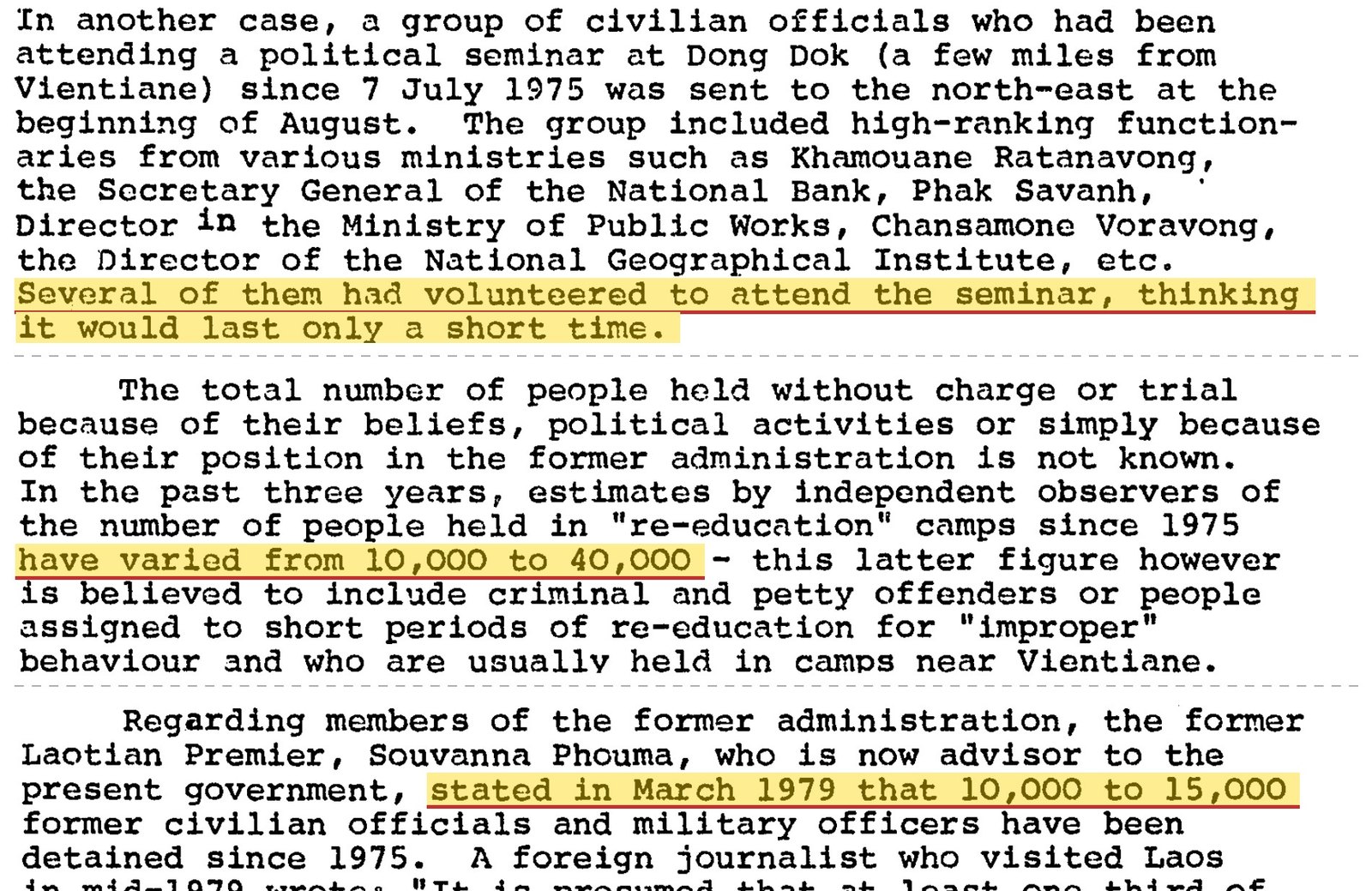
The Library of Congress study likewise confirms that there is no official figure, because the network of camps was kept secret, and that the published figures include 30,000, 37,600 and 50,000 people, with many camps located in Houaphanh Province and referred to by number. The differing figures show that this page of history is still incomplete.
Schools and textbooks
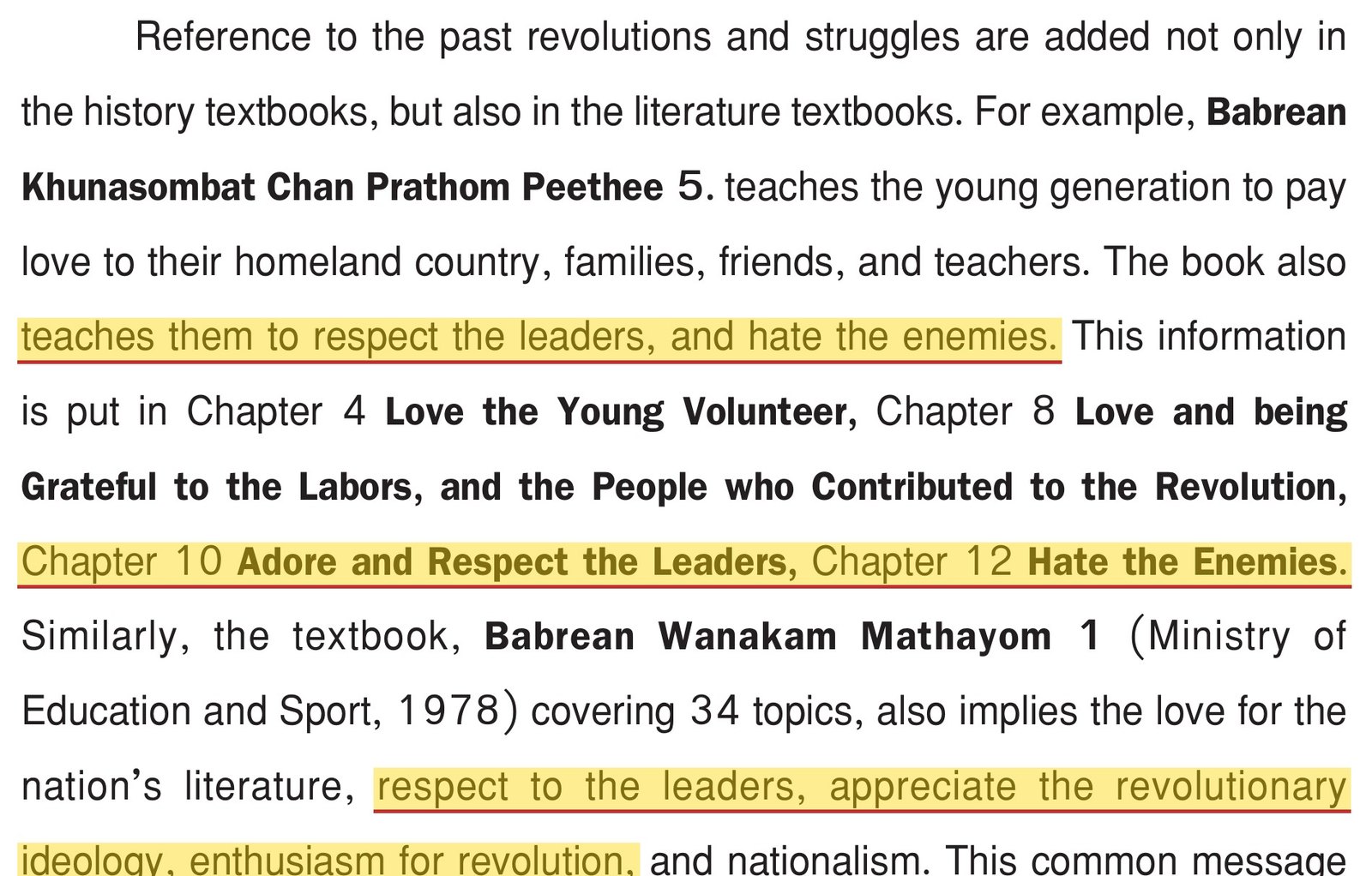
For the younger generation, school is where they meet the Party's ideas from an early age. A study published in the Journal of Mekong Societies in 2005 analysed Lao textbooks from 1949 to 1986 and found that the Grade 5 character-building textbook taught children to love their homeland, family, friends and teachers, together with admiration for the leaders and hatred of the enemies, with lessons titled "Love the Young Volunteer", "Adore and Respect the Leaders" and "Hate the Enemies", while a literature textbook for the first year of lower secondary school from 1978 also taught respect for the leaders and a high regard for revolutionary ideals, and the researchers concluded that the division between "us" and "them" was passed on from primary school.
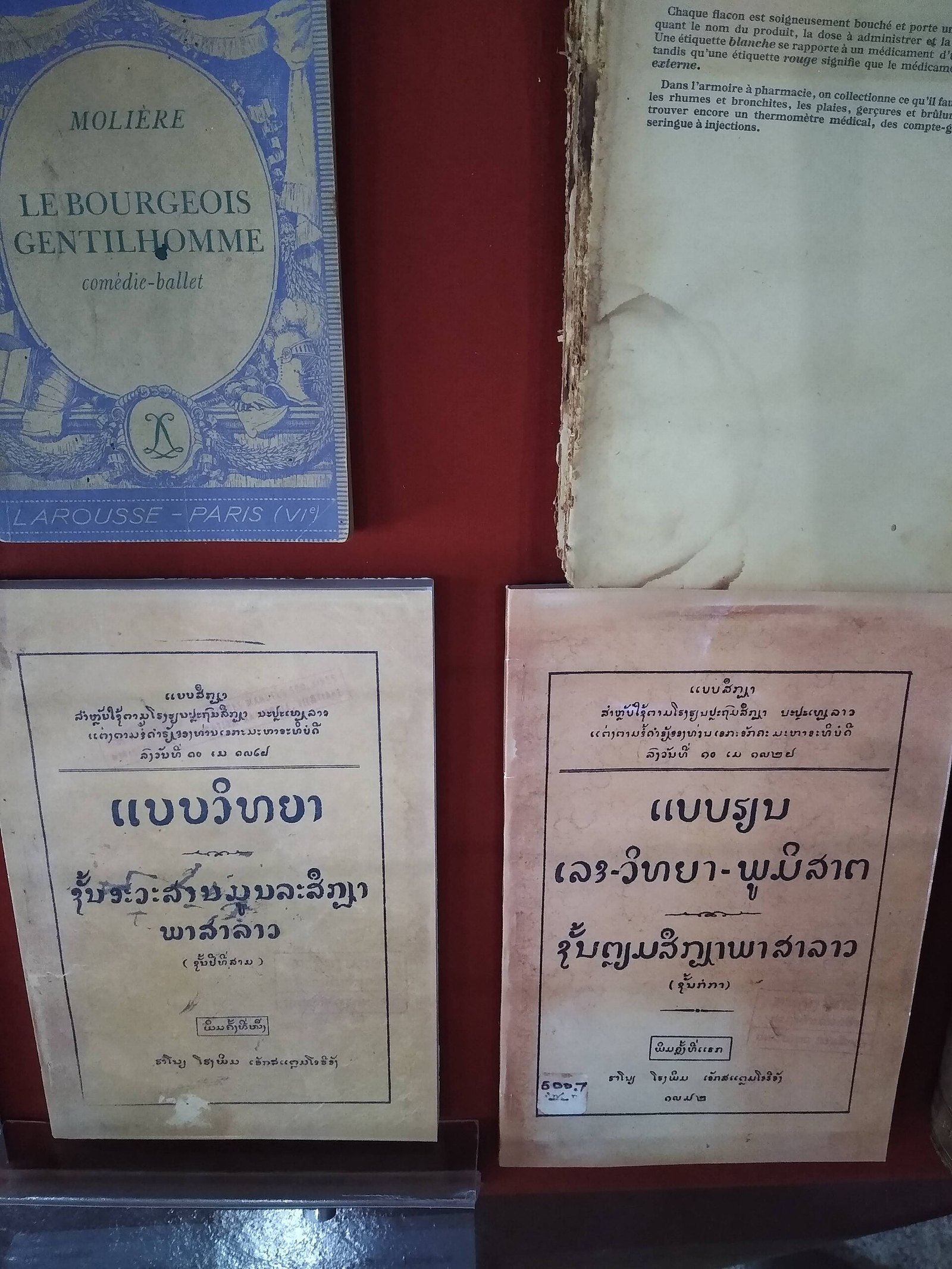
Some of those older textbooks are now exhibits in the Kaysone Phomvihane Museum in Vientiane.
Later the aims of education came to be written in softer language. The historian Martin Stuart-Fox observes that in the earliest drafts of the constitution education had an ideological task of creating the "new man", but in the final draft before adoption in 1991 the only stated aim of education was to create "good citizens", and the phrase good citizens still appears in Article 1 of the revised Education Law of 2015, which aims to turn learners into "good citizens with revolutionary moral qualities", while Article 49 sets the first standard for teachers as having "firm principles, a correct political outlook, and loving and defending the people's democratic regime".
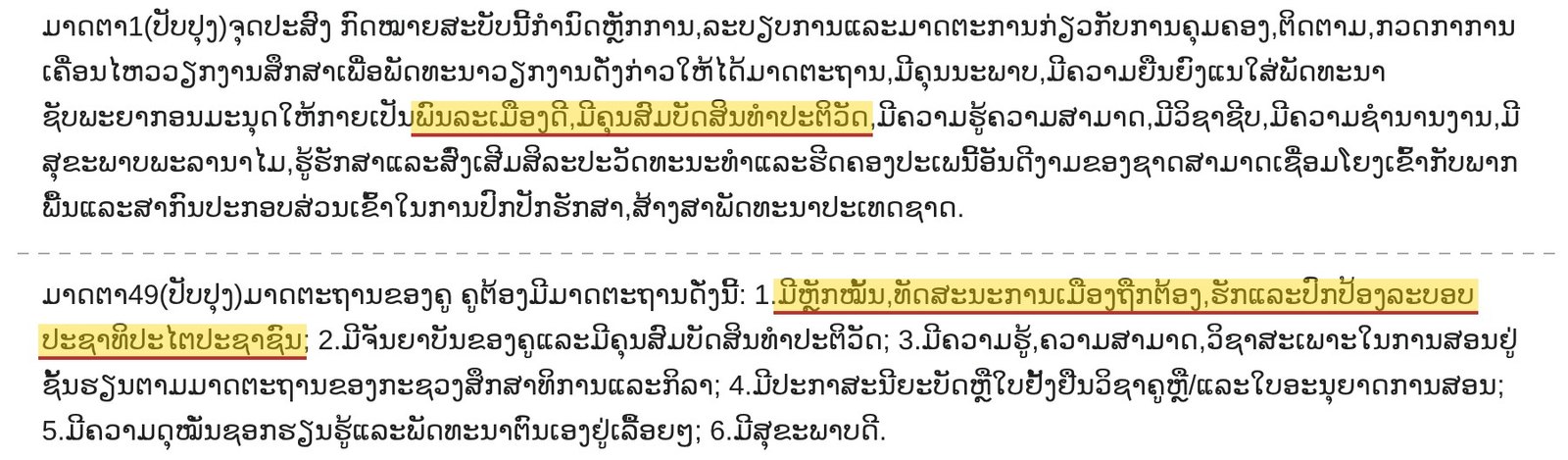
A 2024 study of the civic education textbooks for grades M.1 to M.4 now in use found that the content stresses the rights and duties of citizens, divided into five groups, the last of which is the right and duty to protect the state, so the language of the textbooks has shifted from "hate the enemies" to "citizen duties", although the expectation of defending the regime remains.
From Young Pioneers to Youth Union and Party membership
Beyond the classroom, the Party has organizations that follow children and young people through each age. KPL (the Lao News Agency) reports that the December Young Pioneers, "one of the Party's mass organizations", gather and guide Young Pioneers aged 9 to 14.
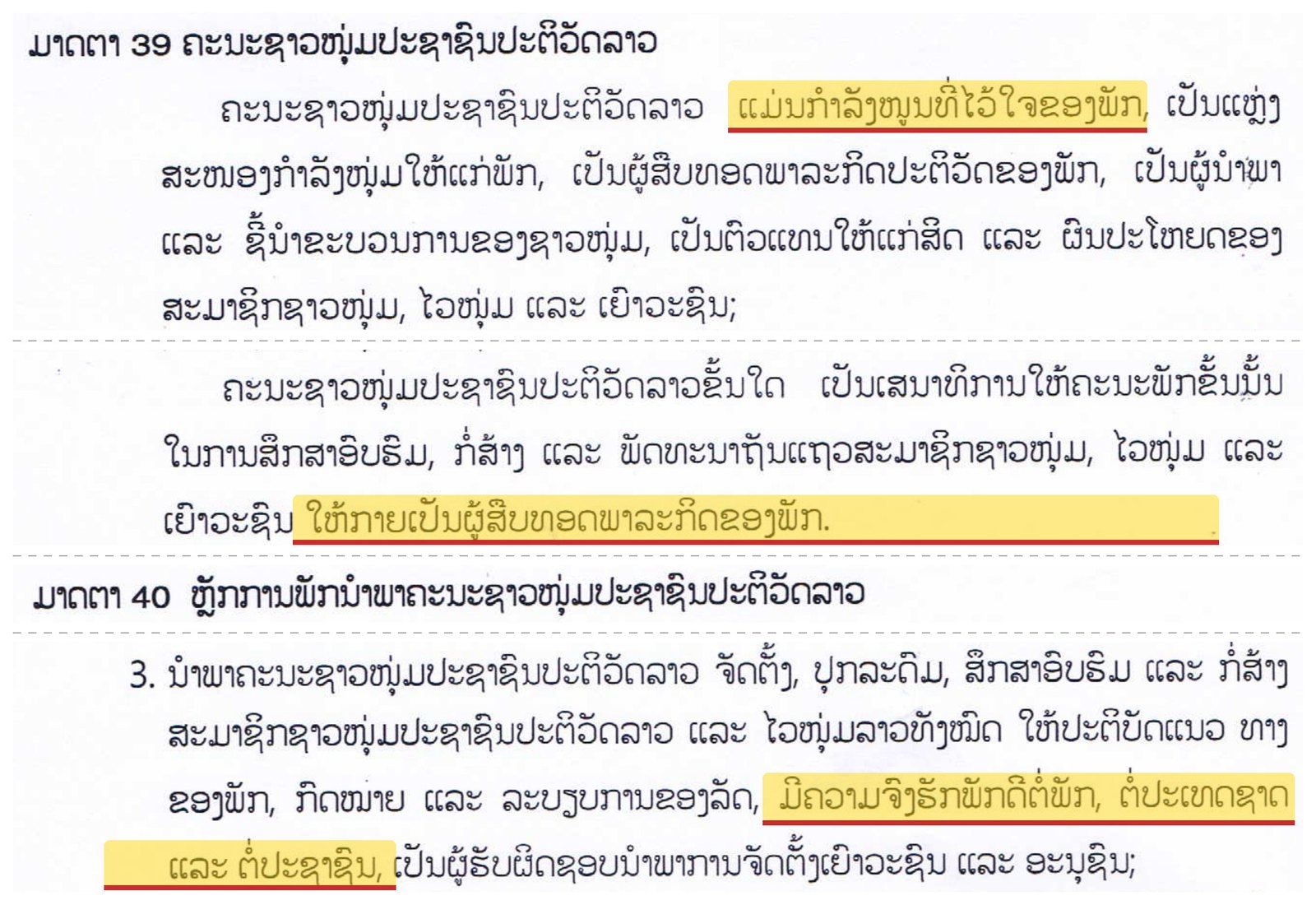
The next step is the Lao People's Revolutionary Youth Union, which Article 39 of the Party Statute defines as the "Party's trusted reserve force" and a source of young strength for the Party, with the task of educating Youth Union members, young people and Young Pioneers "to become successors to the Party's cause", while Article 40 requires the Party to lead the Youth Union in educating all Lao youth to "be loyal to the Party, to the nation and to the people" and makes the Youth Union responsible for leading the organization of Young Pioneers and children.
This path leads directly to Party membership, because Article 1 of the Party Statute says that where a youth organization exists, a young person within the youth age range who wants to become a probationary Party member "must first have been a member of the Lao People's Revolutionary Youth Union" and must be approved by the local Youth Union, so the young person's door to the Party opens through the Youth Union.
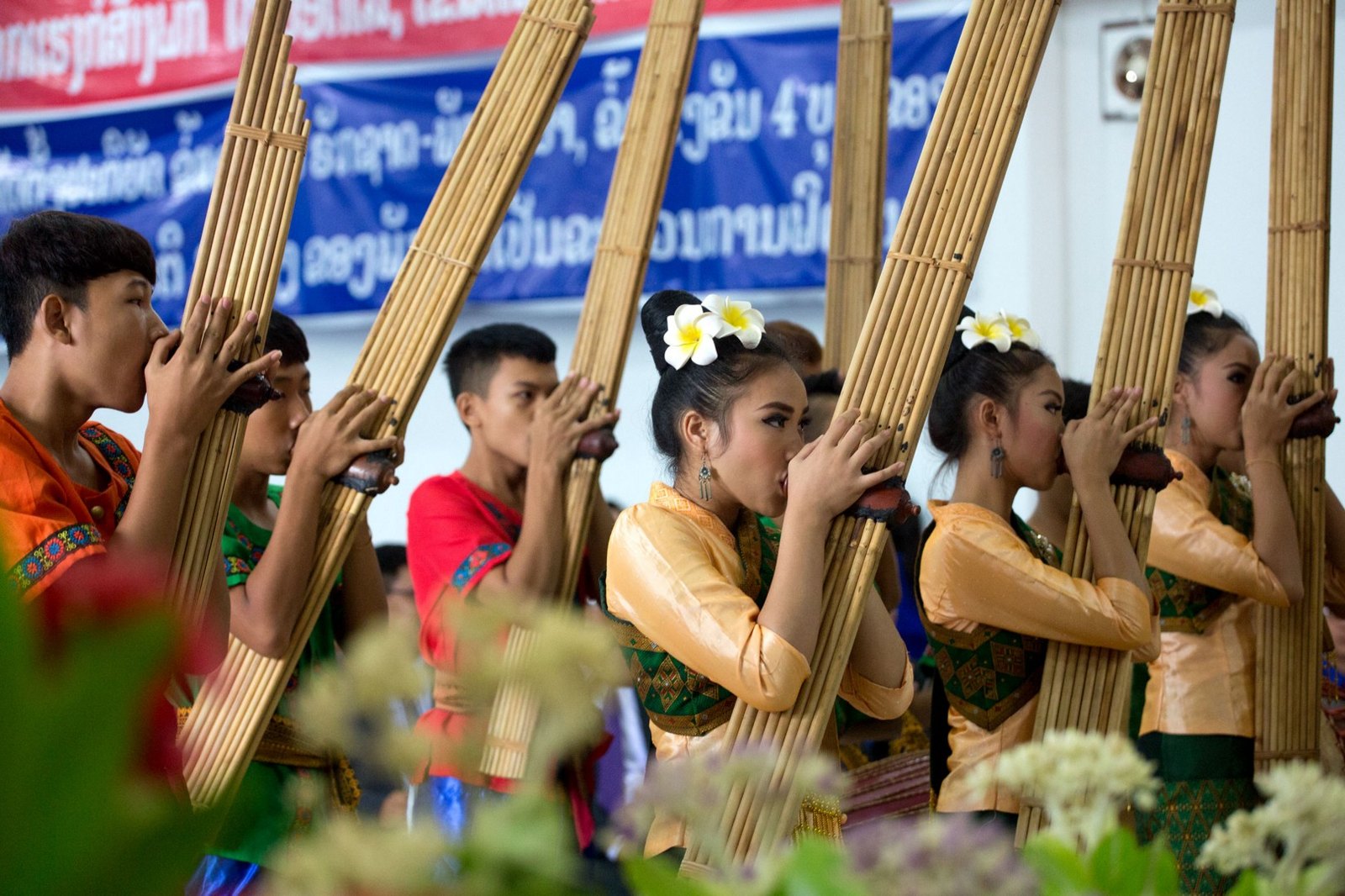
At the celebration of the 70th anniversary of the Youth Union in 2025, the Secretary of the Central Committee of the Youth Union called its members "blue warriors under the banner of the Party", and President Thongloun Sisoulith said that young people should have revolutionary moral qualities, love their country and firmly support the people's democratic regime in order to become worthy successors, so the word "successor" comes back again and again, from the Young Pioneer camps to the Party Statute.
Women, the Front and mass organizations
The relationship between the Party and the mass organizations is written not only in Party documents but also in the Constitution. Article 7 of the 2025 amended Constitution states that the Lao Front for National Construction, the Lao Veterans' Union, the trade unions, the Lao Women's Union, the Youth Union and social organizations are places to "educate, unite and mobilize" people of every class and ethnic group, while Articles 37 and 38 of the Party Statute say that these organizations operate under the "direct and comprehensive" leadership of the Party committee at the same level and have the task of recommending outstanding members for the Party to consider admitting.
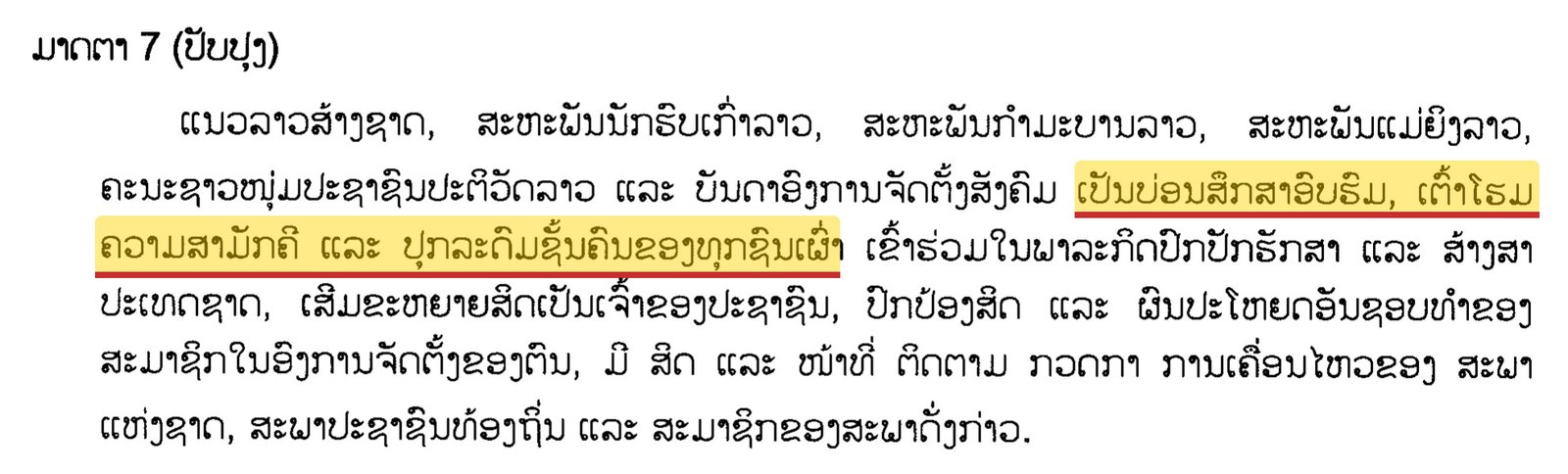
The Lao Women's Union, founded on 20 July 1955, the same year as the Party, is a good example. In July 2025 the Women's Union at the Party Central Office held a celebration of its 70th anniversary, and the first of the eight directions set out at that event was to strengthen political and ideological education for members in order to cultivate revolutionary qualities and patriotism, while the last was to preserve the reputation that "Lao women are outstanding daughters of the Party and of the nation".
The Lao Front for National Construction, which takes 13 August 1950 as its founding date, marked its 75th anniversary in August 2025, when President Thongloun Sisoulith called on the Front at every level to mobilize the people to carry out the resolutions of the Party and the government, and KPL reported that the organization has a role in promoting patriotism and unity among ethnic groups and religions.
The media as a mouthpiece
For the media, Article 2 of the revised Media Law of 4 November 2016 states clearly that the media "have the role of being a mouthpiece of Party organizations, the state and society" in publicizing and educating about the Party's line, the laws and the regulations of the state, as well as "mobilizing patriotic spirit".

Article 6 of the Constitution likewise requires all state organizations and officials to "publicize, disseminate and educate" about policies and laws, so the news of KPL, the newspapers, and state radio and television not only report events but also have the task of explaining and disseminating Party resolutions, and in 2016 KPL further reported that 86 staff of the Party Central Committee's Propaganda and Training Board from across the country took part in 10 days of training in political theory and propaganda work in order to put the Party's policies into effect effectively.
Kaysone Phomvihane: the museum and the statues
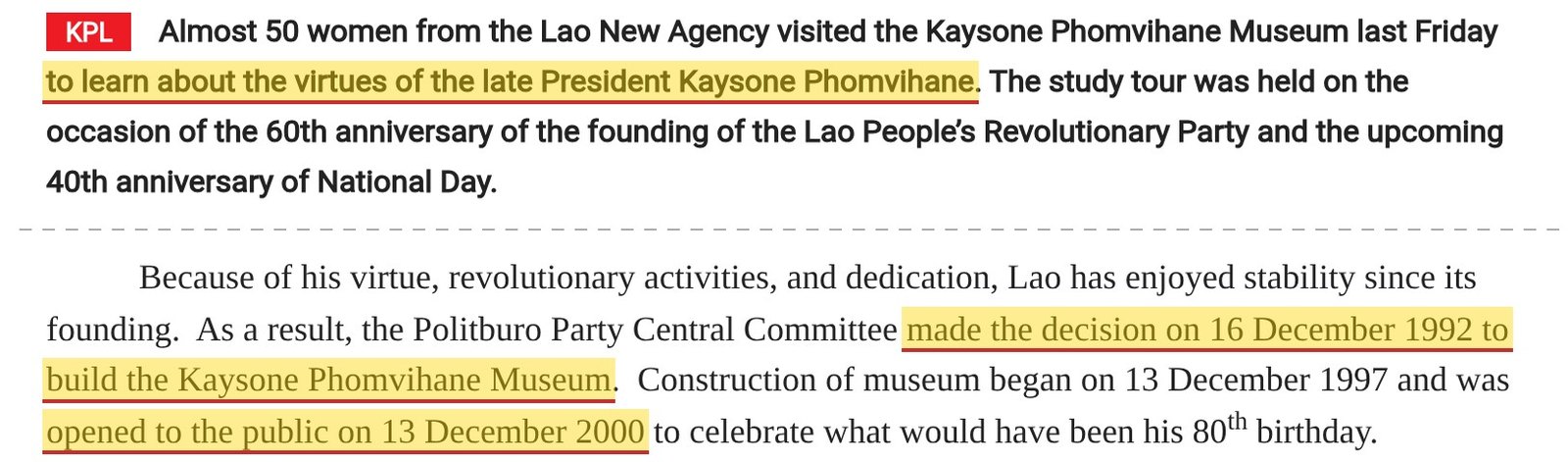
If there is one person at the centre of the cultivation of loyalty to the Party, it is Kaysone Phomvihane, who was born on 13 December 1920 and died on 21 November 1992. Less than a month after his death, the Party's Politburo decided on 16 December 1992 to build the Kaysone Phomvihane Museum, which began construction on 13 December 1997 and opened to the public on 13 December 2000, the 80th anniversary of his birth. The museum has become a place of study visits, for example in March 2015 when almost 50 women staff of KPL visited to learn about and admire his virtues on the occasion of the 60th anniversary of the founding of the Party.
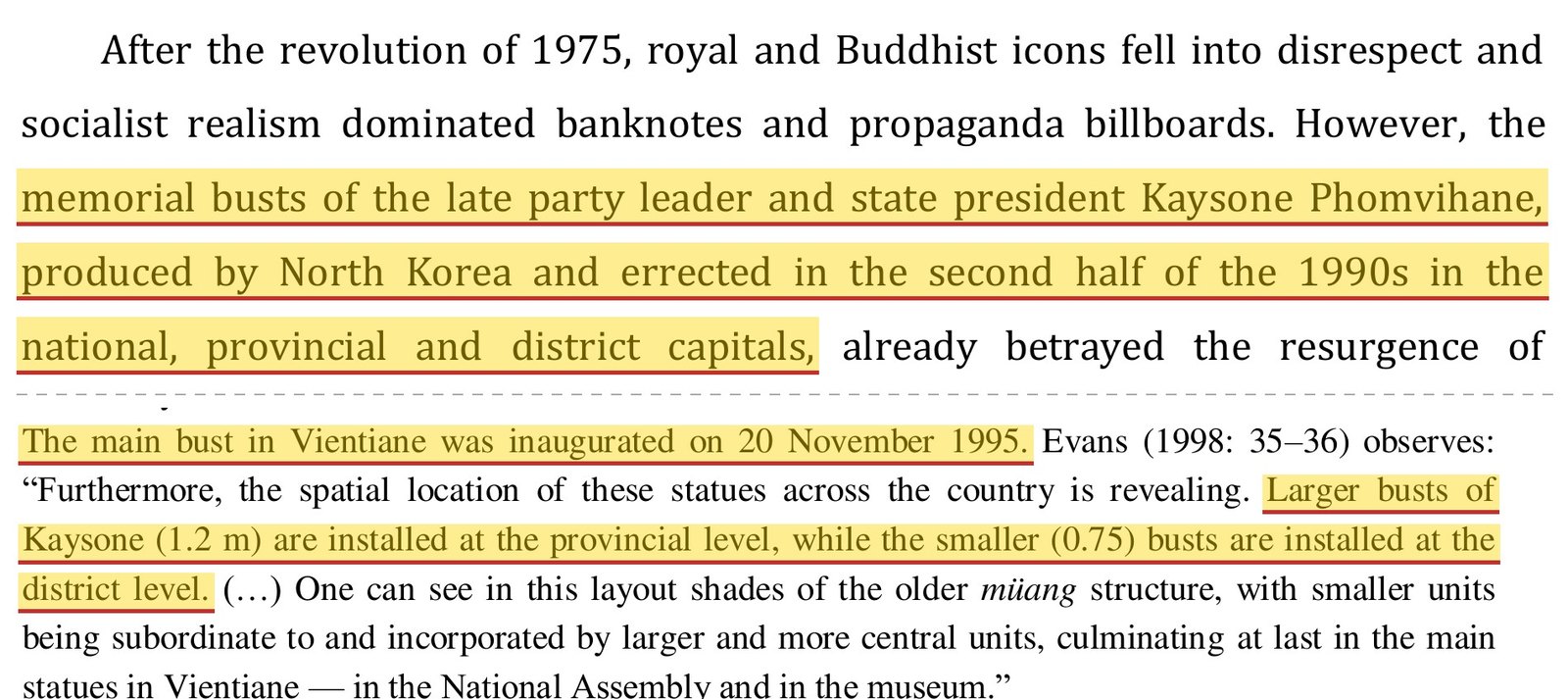
Beyond the museum, admiration for Kaysone also appears in statues, for which the research of Volker Grabowsky and Oliver Tappe in 2011 explains that busts of Kaysone, produced by North Korea, were erected in the second half of the 1990s in the capital, the provincial capitals and the district towns, each standing on a pedestal decorated with a lotus pattern and topped with a nine-tiered roof, a symbol of Buddhist kingship, that the main statue in Vientiane was inaugurated on 20 November 1995, and that the anthropologist Grant Evans observed that the larger busts, 1.2 metres high, stand at provincial level and the smaller ones, 0.75 metres, at district level, like the structure of large and small towns in ancient times, and that his image has also appeared on the kip banknote since 1997.
This building of memory continues to the present: on 15 June 2021 another Kaysone memorial was opened in Vilabouly District, Savannakhet Province, and a study published in the Journal of Mekong Societies in 2013 concluded that Lao literature from 1975 to 2010 built a memory of Kaysone as a revolutionary leader and national hero by choosing to remember some things and leaving others unmentioned.
Anniversaries and ceremonies
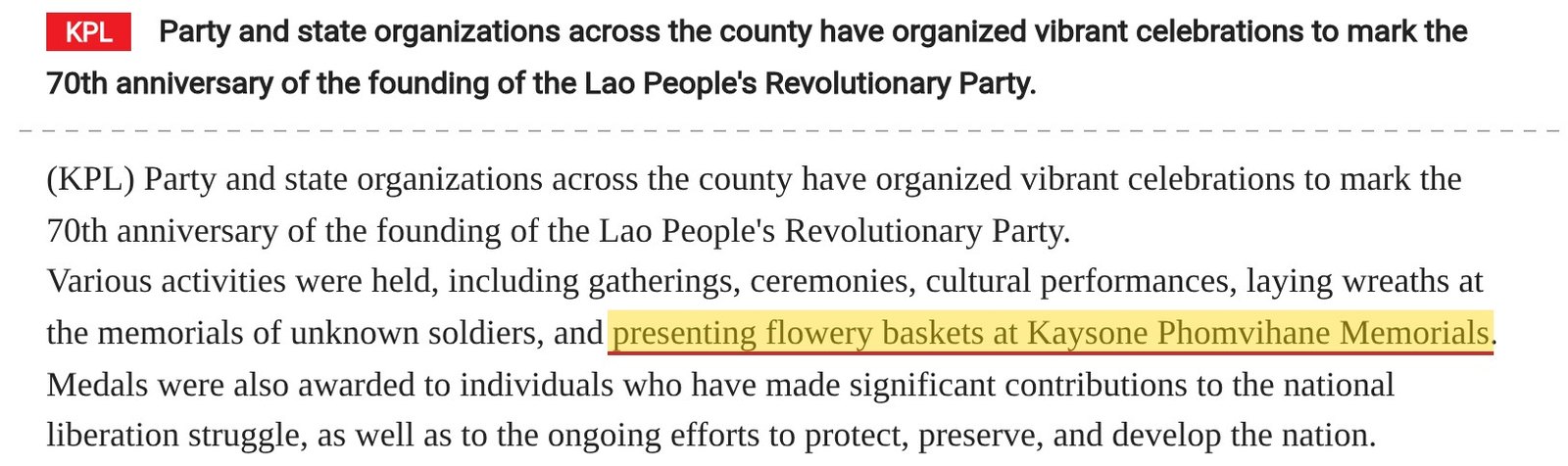
The Lao calendar is full of anniversaries tied to the Party: Army Day on 20 January 1949, the founding of the Party on 22 March 1955, the founding of the Women's Union on 20 July, the founding of the Lao Front for National Construction on 13 August, National Day on 2 December and Kaysone's birthday on 13 December. For the 70th anniversary of the founding of the Party in March 2025, KPL reported that Party and state organizations across the country held gatherings, ceremonies and art performances, laid wreaths at the Monument to the Unknown Soldier and presented flower baskets at the Kaysone Phomvihane memorials, with soldiers, police, officials and students taking part.
One of the largest ceremonies took place on 24 March 2012, when the remains of 14 revolutionary leaders, including Kaysone Phomvihane and Prince Souphanouvong, were moved to a new national mausoleum covering 52 hectares and costing about 150 billion kip. The anthropologist Oliver Tappe records that the ceremony had 120 monks to officiate, an honour guard, and Youth Union members lining both sides of the road, a blending of Party ritual with Buddhist tradition.
The Party in the state and the army
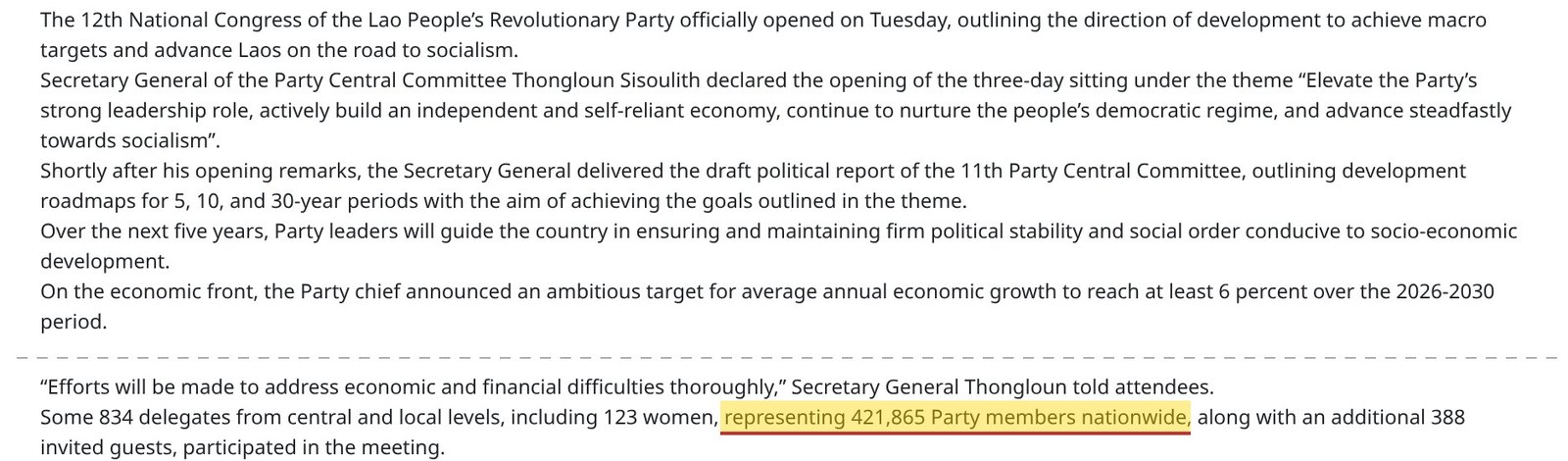
The cultivation of loyalty to the Party does not stop at school but continues in the workplace, especially in the state sector. The Library of Congress study explains that the Party follows the general pattern of communist parties by placing Party members in every major institution of society, both in the state and in mass organizations, to lead and pass on the Party's line, Article 37 of the Party Statute has the Party choose Party members and officials to stand for election or to be appointed to state bodies, and in January 2026 the Party's 12th Congress had 834 delegates representing 421,865 Party members across the country.
For leading officials, a study published in a social science journal in 2025 found that from 2018 to 2022 the Party and the government continuously sent leading and managing officials to upgrade their political theory, both within the country and in China and Vietnam.
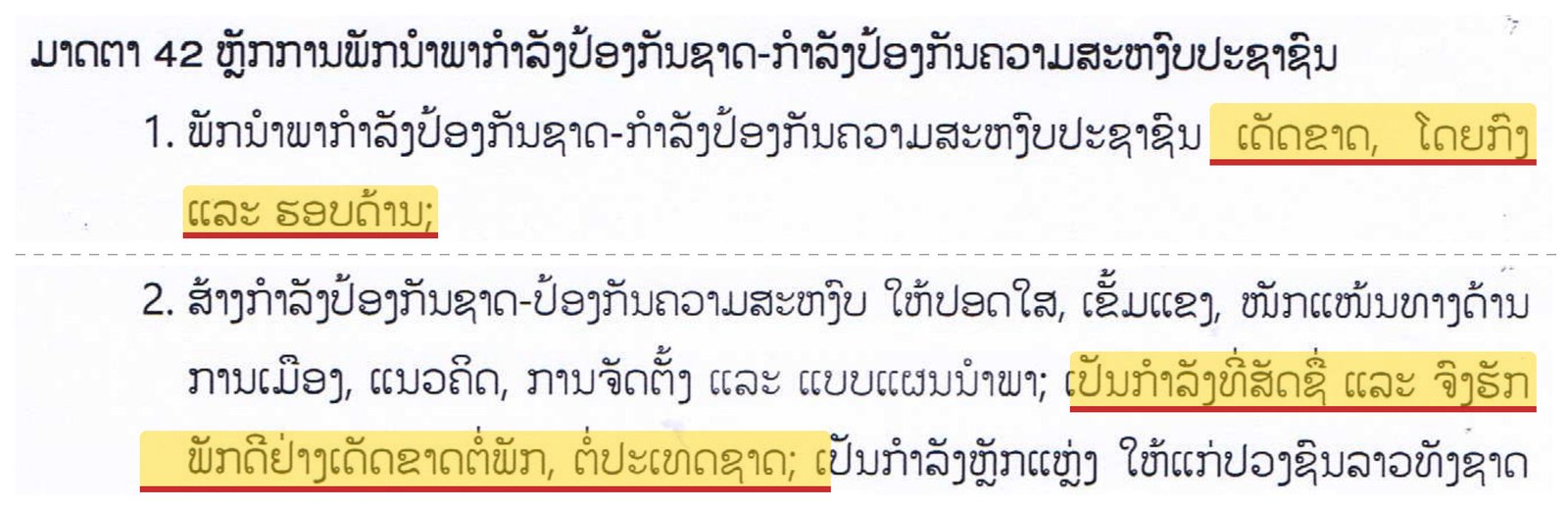
The army and the security forces are where the language of loyalty is most intense. Article 42 of the Party Statute requires the Party to lead these forces "resolutely, directly and comprehensively" and makes them a force that is "loyal and absolutely faithful to the Party and to the nation".
What was let go and what was kept
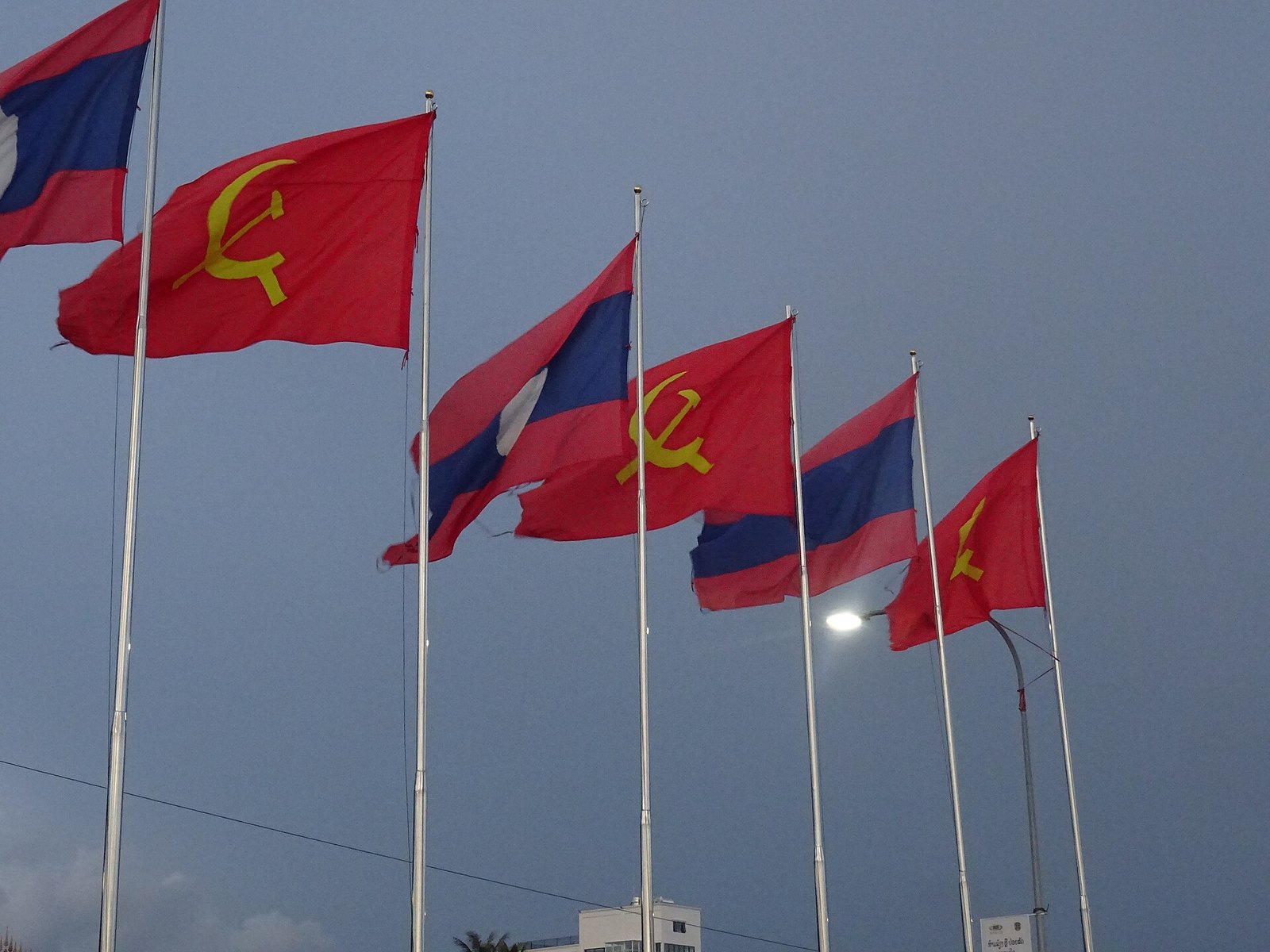
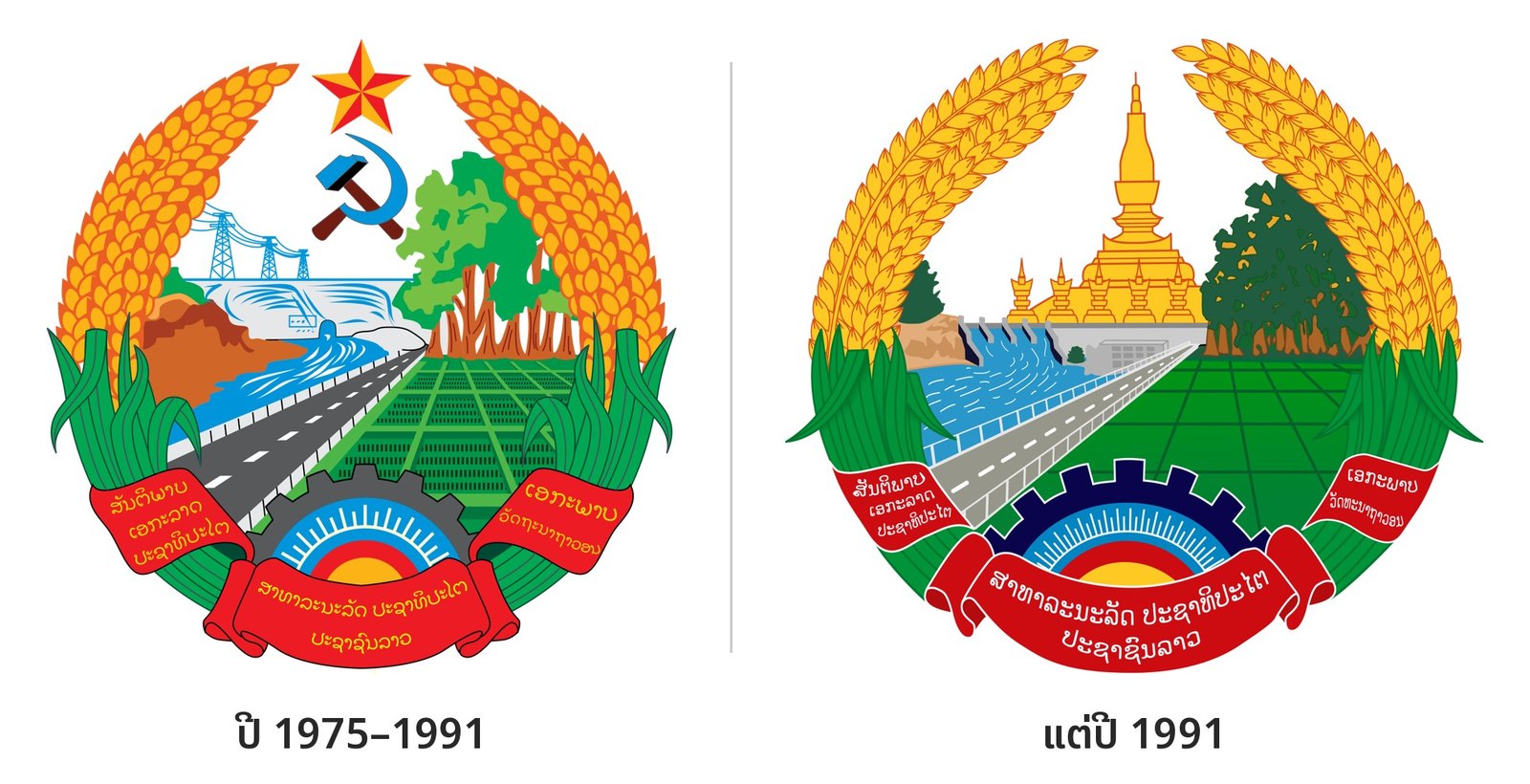
Looking at the whole history, one sees that the Party has let go of many things that used to be its symbols. The Library of Congress study records that from the late 1980s to the early 1990s, as aid from the Soviet Union declined, Lao leaders increasingly abandoned the burden of socialist ideology, ended collective farming and moved toward a market economy, and in the 1991 Constitution the national emblem also changed, with Stuart-Fox writing that "the hammer and sickle and gold star at the apex of the emblem have disappeared", replaced by the image of the That Luang stupa.
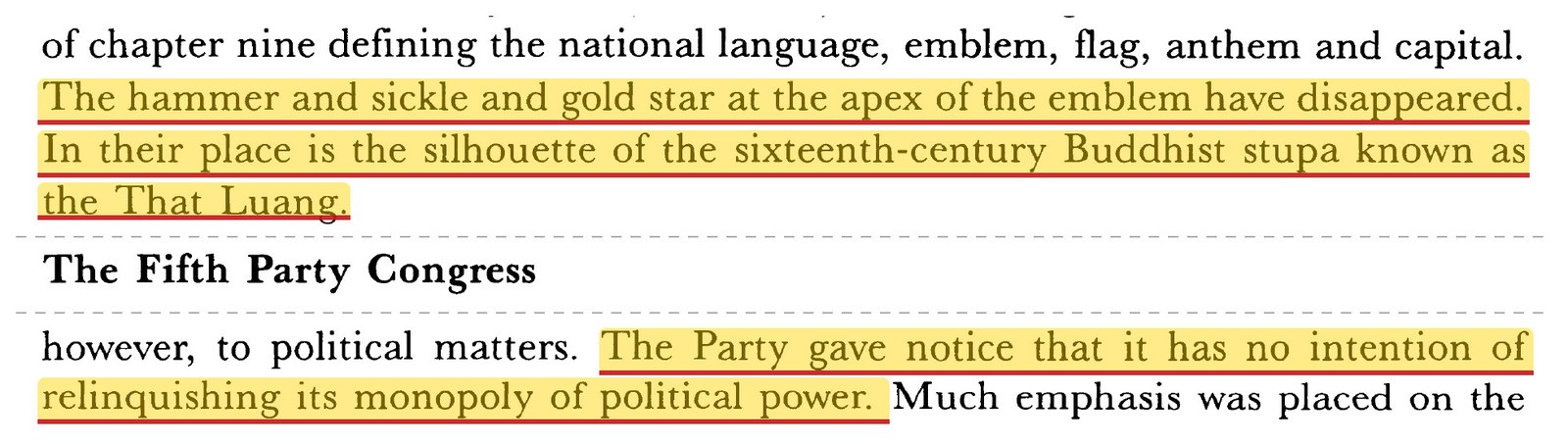
But in the same chapter Stuart-Fox also records that the Party's 5th Congress in March 1991 announced that the Party had "no intention of relinquishing its monopoly of political power", and the Library of Congress study concludes in a similar way that the most important things remaining from the old system are the single ruling party, the symbols, the economic policy and the language of the textbooks, which could change, but the Party's leadership and the education in loyalty to the Party have been kept.
Loyalty, taught down the generations
From a Party operating secretly behind the Lao Patriotic Front in 1956 to a Party with more than 400,000 members in 2026, the way loyalty is cultivated has changed from seminars and the lesson "Hate the Enemies" to museums, statues and Young Pioneer camps, but the aim written in the Party's documents remains the same: to create a new generation that is loyal to the Party and that are the Party's "successors".
What these documents can tell us is what the Party intends Lao people to feel and remember, while how each Lao person who has grown up through these schools, Young Pioneer camps and ceremonies feels about the Party is an answer that each person holds in their own heart.


